

You need surgery on your lung or chest, and then you hear “Open surgery,” “VATS,” and “Robotic surgery,” leading to the natural question “Which one is best?”, the answer to which depends on what needs to be treated and where it is located, because while traditional open thoracic surgery provides broad access to the chest and remains important for complex tumors, difficult anatomy, major reconstructions, and cases where extensive exposure is required, video-assisted thoracoscopic surgery (VATS) uses a camera and small incisions and is widely used for selected pulmonary and thoracic procedures, and robotic thoracic surgery offers another minimally invasive approach where the surgeon controls a robotic platform that provides enhanced visualization and articulated instruments, with the AATS describing both VATS and robotic surgery as established minimally invasive approaches for selected thoracic procedures.
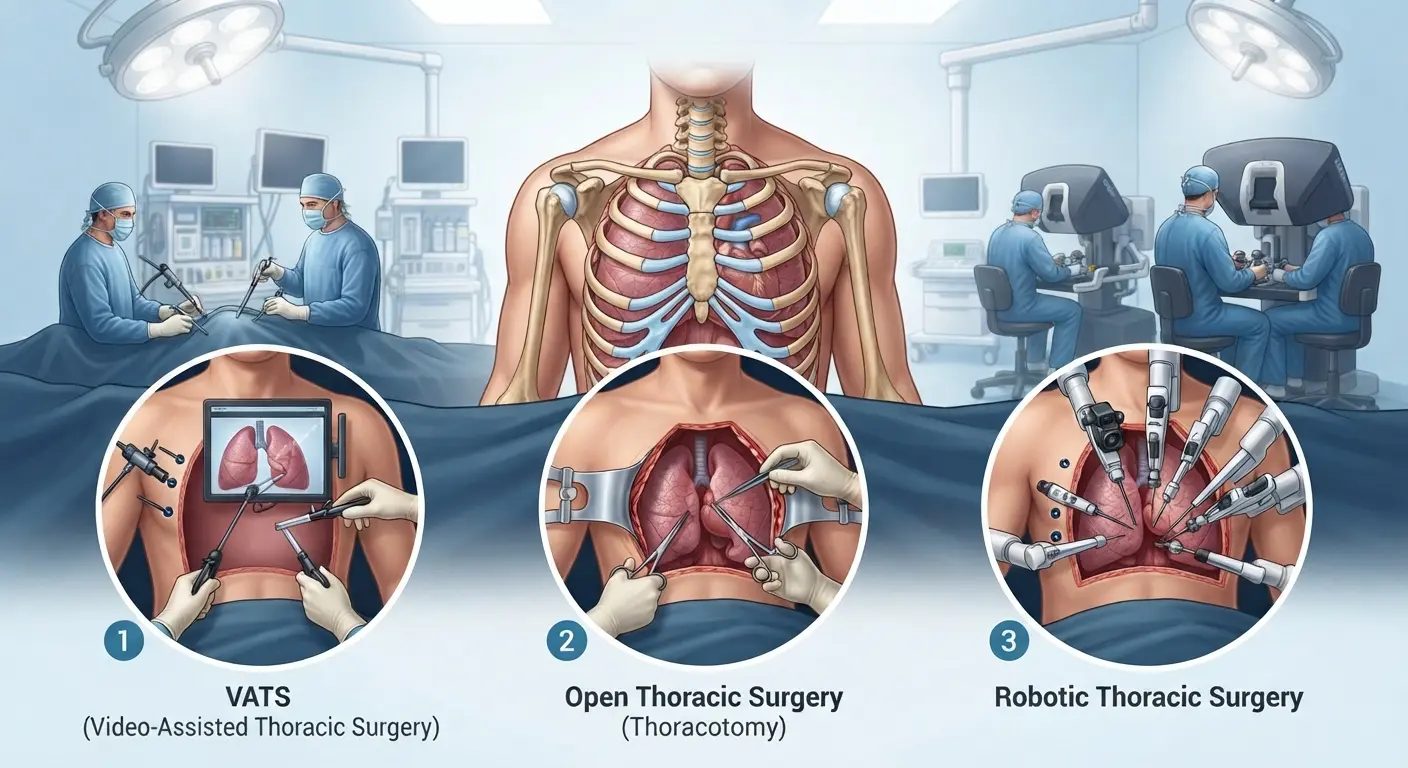
For selected procedures, minimally invasive surgery may reduce surgical trauma and speed recovery.
But open surgery may provide safer access for complex cases.
Not automatically.
Recent thoracic literature continues to compare the two approaches, and differences in outcomes can be modest for some procedures despite technical differences.
Yes, in selected patients.
Depending on tumor size, location and stage, minimally invasive lobectomy, segmentectomy or other resections may be possible.
No.
The surgeon controls the robotic instruments throughout the operation.
Yes.
Conversion to open surgery may be necessary when safety or adequate tumor/lesion treatment requires greater access.
Usually minimally invasive techniques have smaller incisions than open thoracotomy.
But:
The smallest scar is not the main measure of a successful thoracic operation.
The real goals are:
Complete treatment
Safe surgery
Preservation of healthy tissue when possible
Good postoperative recovery
The thoracic surgeon may consider:
Tumor or disease type
Location
Size
Stage
Relationship to major structures
Previous surgery
Patient's lung function
Surgeon's experience
Available technology
Thoracic Surgery in Egypt for International Patients
For international patients, send:
CT chest
PET-CT when relevant
Bronchoscopy reports
Pathology/biopsy
Pulmonary function tests
Previous treatment records
The surgeon can then determine whether VATS, robotic or open surgery may be appropriate.
Don't choose the technology first.
Choose the treatment plan first—and let the technology serve that plan.
+2011 10078666
+2011 10078666
info@shencure.com